Bible ↗“Two are better than one, because they have a good reward for their labor.”
Ecclesiastes 4:9After observing loneliness and exhausting work, Ecclesiastes describes the practical value of companionship. It celebrates mutual support rather than assuming that everyone must have the same relationships.
In context: A neighbor who lives independently needs help moving a heavy piece of furniture. Rather than risking injury or treating the request as weakness, they arrange for another person to assist and agree on a safe time. Both contribute to a task that would have been harder alone, without assuming they must share every other part of life.
Bible ↗“My help comes from Yahweh, who made heaven and earth.”
Psalm 121:2This pilgrim song links help with the Creator and continues with images of watchfulness. Its focus is trust in God's care, not an exemption from every hardship.
In context: Before a long journey, someone recites this psalm as part of their tradition. They also check road conditions, pack needed medicine and share their itinerary with a trusted person. Prayer and responsible planning can coexist without making either a substitute for the other.
Bible ↗“Yahweh is my shepherd; I shall lack nothing.”
Psalm 23:1The opening metaphor introduces a psalm of guidance, nourishment and companionship even through danger. It is a confession of trust, not a promise of luxury.
In context: A family facing an uncertain move reads Psalm 23 together. They still make a budget, ask friends for practical help and allow themselves to feel worried. The familiar image gives them language for hope while they deal with ordinary decisions that faith does not make for them.
Bible ↗“Therefore don’t throw away your boldness, which has a great reward.”
Hebrews 10:35Written to a community facing difficulty, this encouragement invites perseverance in trust rather than a promise of instant success. The surrounding verses remember endurance under pressure.
In context: Someone who has been mocked for taking part in a faith community feels uncertain about attending again. A trusted member listens, acknowledges the real cost and offers to accompany them if they choose. Courage may mean returning thoughtfully, not pretending the experience was harmless.
Bible ↗“And be kind to one another, tender hearted, forgiving each other, just as God also in Christ forgave you.”
Ephesians 4:32Paul places kindness and forgiveness beside warnings against speech that harms a community. The verse does not ask readers to deny harm or abandon wise boundaries.
In context: After a volunteer speaks sharply during a meeting, a colleague explains the effect of the remark without humiliating them. The volunteer takes responsibility, apologizes and changes how future disagreements are handled. Others leave room for repair while maintaining the group's shared expectations.
Bible ↗“As you would like people to do to you, do exactly so to them.”
Luke 6:31In Jesus' teaching about kindness toward opponents and generosity, this sentence asks listeners to consider others' good through their own experience of dignity.
In context: A club organizer remembers how confusing an unfamiliar venue can feel and sends visitors clear transport, entrance and access details. Rather than assuming everyone has identical needs, the organizer asks whether further information would help.
Bible ↗“Come to me, all you who labor and are heavily burdened, and I will give you rest.”
Matthew 11:28Jesus invites burdened listeners to come to him. The next verses explain this rest through his teaching and gentle way, so the promise is best read in that context.
In context: Someone exhausted by family responsibilities reads Matthew 11:28–30 in a quiet moment, names the pressure honestly in prayer, and then asks a trusted person for help with one task. The spiritual response and practical support can coexist instead of competing.
Bible ↗“Bear one another’s burdens, and so fulfill the law of Christ.”
Galatians 6:2This line follows a call to restore people gently. Carrying another's burden means sharing real difficulties, while the surrounding passage also addresses personal responsibility.
In context: A community member returning after an injury needs help reaching a weekly gathering. Volunteers ask what support would be useful, arrange a temporary lift schedule with consent, and revisit the plan rather than assuming that one unpaid helper should do it indefinitely.
Bible ↗“Rejoice with those who rejoice. Weep with those who weep.”
Romans 12:15In a chapter about sincere love and shared life, Paul places celebration and grief side by side. The invitation is to meet others honestly in their circumstances.
In context: A colleague receives good news while another is facing a difficult family week. Their team congratulates the first person without asking everyone to feel cheerful, and offers practical cover to the second without insisting on personal details. Each response fits the person and the moment rather than a single required office mood.
Bible ↗“But be doers of the word, and not only hearers, deluding your own selves.”
James 1:22James contrasts merely hearing instruction with practicing it. The surrounding passage uses the image of a person forgetting their reflection to describe knowledge without lived response.
In context: A volunteer group discusses welcoming visitors who have trouble reading its signs. After listening, members test a clearer entrance notice, ask a visitor to check it and make an improvement. The point is not how much the group talked about welcome, but whether its next encounter became easier for someone else.
Bible ↗“A friend loves at all times; and a brother is born for adversity.”
Proverbs 17:17The proverb values loyalty when circumstances are hard, not only pleasant companionship. Its parallel lines connect friendship and family responsibility without suggesting that every relationship is safe.
In context: A friend misses several gatherings while caring for a relative. Instead of treating the absence as rejection, another friend checks in privately and offers a practical errand, while accepting that help may be declined. Loyalty appears in respectful attention, not a demand for updates.
Bible ↗“A gentle answer turns away wrath, but a harsh word stirs up anger.”
Proverbs 15:1The proverb contrasts two ways speech can shape a tense encounter. A gentle answer may lower the temperature without requiring a person to excuse mistreatment.
In context: Two relatives disagree about a family arrangement. One notices that the conversation is becoming personal and says, 'I disagree with that plan, but I want to hear why it matters to you.' The disagreement remains, yet both have a better chance of discussing the actual decision rather than defending themselves against an insult.
Bible ↗“Be at peace among yourselves.”
1 Thessalonians 5:13This instruction appears in a passage about honoring service and caring for a community. The following lines also call for patience and support toward those who struggle.
Bible ↗“Pray without ceasing.”
1 Thessalonians 5:17Paul includes prayer among brief instructions about communal life, gratitude, patience and testing what is good. This is not a demand to avoid ordinary responsibilities.
Bible ↗“For everything there is a season, and a time for every purpose under heaven:”
Ecclesiastes 3:1The poem pairs joy with sorrow and gain with loss. The line introduces life's contrasting seasons rather than promising that every circumstance immediately makes sense.
Bible ↗“Pride goes before destruction, and an arrogant spirit before a fall.”
Proverbs 16:18This wisdom saying warns how pride can keep a person from seeing risk and receiving correction. It is a proverb, not a prediction about every proud person.
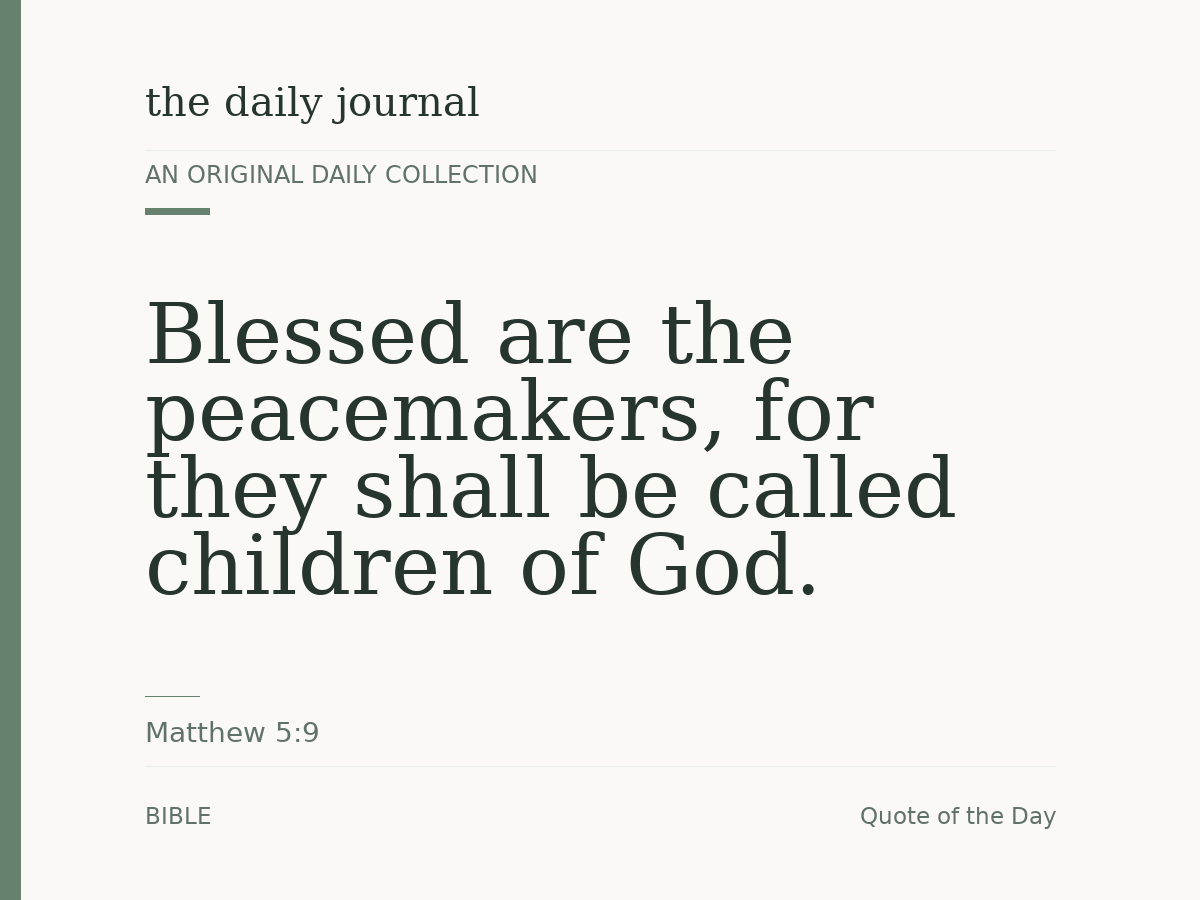
Bible ↗“Blessed are the peacemakers, for they shall be called children of God.”
Matthew 5:9Jesus places peacemaking among the attitudes that mark his followers in the Sermon on the Mount.
Bible ↗“Be still, and know that I am God.”
Psalm 46:10The call to stillness follows a description of conflict and God's power over nations; it should not be reduced to a generic relaxation slogan.