Courage ↗“The empty chair at the table can be a question of fairness.”
Quote of the Day EditorialWhen a decision affects a group that is absent from the discussion, the missing perspective matters. Inviting input is not a decorative gesture; it can change which concerns and costs are recognized.
Courage ↗“A warning bell is useful because someone was willing to ring it.”
Quote of the Day EditorialWarnings do not always arrive in a confident voice. The person who raises a credible safety concern deserves a careful hearing and a response based on evidence, even when the warning interrupts a popular plan.
Courage ↗“Bravery can sound like a calm question asked at the right time.”
Quote of the Day EditorialA calm question may expose a missing assumption at precisely the moment others want to move forward. The courage lies in seeking clarity without treating disagreement as a contest for attention.
Courage ↗“The honest apology may be the bravest part of a disagreement.”
Quote of the Day EditorialAn apology matters when it names an actual mistake and accepts responsibility. Saying sorry does not entitle the speaker to forgiveness, nor does it substitute for repair where repair is possible.
Courage ↗“Courage is not always a leap; sometimes it is returning to a hard task.”
Quote of the Day EditorialReturning to an unfinished or demanding task can require willingness to face earlier difficulty. A sensible return can also mean revising the method or asking for support rather than simply persisting without limits.
Courage ↗“Bravery can look like admitting you need more information.”
Quote of the Day EditorialAdmitting that a decision needs more information resists pressure to sound certain. In a group making consequential choices, that admission may prevent guesses from being mistaken for established facts.
Courage ↗“You may be nervous and still be well prepared.”
Quote of the Day EditorialNerves are not proof of incompetence. Someone may have prepared carefully and still feel uneasy before an interview, examination or public contribution; preparation and emotion are separate realities.
Courage ↗“The first honest conversation may be the hardest step.”
Quote of the Day EditorialOpening a difficult conversation can demand more preparation than its first sentence suggests. Naming the problem without accusation may make shared facts possible, though sometimes mediated or written communication is safer.
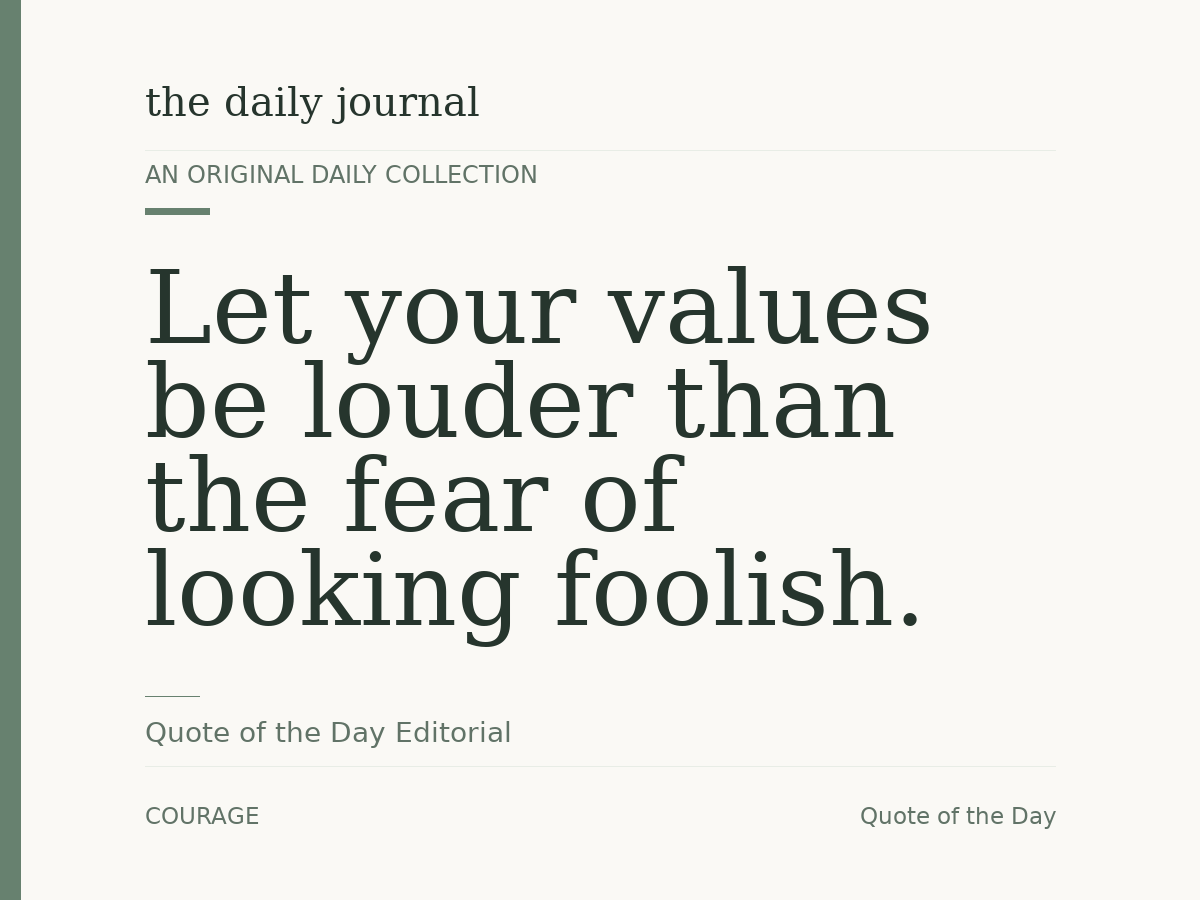
Courage ↗“Let your values be louder than the fear of looking foolish.”
Quote of the Day EditorialFear of embarrassment can influence which principles people voice or practice. Holding to a value becomes more meaningful when the choice is thoughtful rather than driven by winning approval from a crowd.
Courage ↗“A boundary can be an act of courage and kindness.”
Quote of the Day EditorialSetting a clear limit can protect both the speaker and people affected by an unreasonable request. The line does not imply that every boundary is safe to announce publicly or that others must react well.
Courage ↗“The brave choice is sometimes to change course.”
Quote of the Day EditorialChanging direction after a new fact emerges can mean caring more about the result than about defending the original plan. The quotation favors judgment over the social pressure to look consistent.
Courage ↗“Asking for help is a form of moving forward.”
Quote of the Day EditorialReaching for relevant help can interrupt isolation and prevent avoidable errors. This is not a claim that every person has equal access to support; asking is an option, not a test of character.
Courage ↗“You may feel afraid and still take the next responsible step.”
Quote of the Day EditorialFeeling afraid does not make a decision irresponsible. The important distinction is whether the next action is proportionate, informed and safe for the people affected, rather than whether fear has disappeared.
Courage ↗“Courage can speak softly and still mean every word.”
Quote of the Day EditorialA person can insist on an important point without performing anger or certainty. A measured voice may be the most faithful way to communicate a difficult truth when the listener is defensive.