Teacher ↗“A student’s accent is not the limit of their understanding.”
Quote of the Day EditorialLanguage fluency and subject comprehension do not always develop at the same pace. Multiple ways to express an answer can reveal knowledge while language skills continue to grow.
In context: In a science class, a multilingual student explains an experiment with hesitant pronunciation but accurate observations. The teacher asks a clarifying question, reviews the student's written diagram and assesses the scientific reasoning rather than treating accent as a mistake in the hypothesis.
Teacher ↗“The best classroom technology leaves more attention for the lesson.”
Quote of the Day EditorialA tool earns its place when it improves access, explanation, feedback, or practice. Novelty by itself is not evidence that students are learning better.
Teacher ↗“A useful homework task has a reason beyond filling the evening.”
Quote of the Day EditorialPractice can reinforce learning, but assignments should have a clear purpose and take student circumstances into account. More work is not automatically more education.
Teacher ↗“Students learn what a fair correction looks like by watching one happen.”
Quote of the Day EditorialWhen a teacher acknowledges an error and explains the revision, the class sees intellectual honesty practiced. Authority need not depend on pretending to be infallible.
Teacher ↗“A teacher cannot pour from an empty timetable.”
Quote of the Day EditorialPreparation, feedback, and personal support all require time. Sustainable teaching depends partly on realistic workloads and institutional resources, not solely on individual dedication.
Teacher ↗“The quietest hand is not always the quietest mind.”
Quote of the Day EditorialSpeaking frequency is an imperfect measure of engagement. Writing, small-group discussion, and individual checks can give more learners ways to show what they understand.
Teacher ↗“The student who needs more time still deserves a demanding question.”
Quote of the Day EditorialSupport and high expectations are compatible. Teachers can offer processing time or scaffolding while continuing to invite substantial thinking rather than assuming difficulty means inability.
Teacher ↗“The pause after a question belongs to the student too.”
Quote of the Day EditorialSilence after a question does not always mean disengagement. Giving learners time to think can make participation less dependent on who answers fastest.
In context: During a history discussion, a teacher asks why two accounts of the same event differ. They give students time to write a sentence before inviting answers, allowing quieter learners to develop a reason instead of racing the quickest hands.
Teacher ↗“A teacher leaves room for the answer that arrives slowly.”
Quote of the Day EditorialSome answers require more processing time or the use of a different language or method. Leaving room for careful responses can make discussion more thoughtful without dismissing quicker learners.
Teacher ↗“Teaching asks for preparation; learning asks for room to surprise it.”
Quote of the Day EditorialWell-planned instruction supports coherence, but students bring gaps and insights that no script predicts. Reflection on those surprises can improve the next lesson.
Teacher ↗“A good rubric lets students see the target before the arrow leaves the bow.”
Quote of the Day EditorialClear criteria help learners direct their effort and understand later feedback. A rubric must still allow for thoughtful, unexpected approaches rather than rewarding only conformity.
Teacher ↗“A classroom can be orderly and still leave questions unanswered.”
Quote of the Day EditorialSilence alone does not establish understanding. Short checks for explanation, independent practice, or anonymous questions can reveal misconceptions that a quiet room conceals.
Teacher ↗“The second explanation is not a defeat for the first.”
Quote of the Day EditorialChanging approach after students remain confused shows responsiveness. A diagram, demonstration, analogy, or slower sequence may clarify what the initial presentation could not.
Teacher ↗“A question deserves attention even when the timetable cannot give it an answer yet.”
Quote of the Day EditorialTeachers cannot pursue every detour immediately. Recording an interesting question and returning to it when possible can respect curiosity while keeping a class on track.
Teacher ↗“A red mark locates a problem; a useful comment helps repair it.”
Quote of the Day EditorialPointing out an error can be necessary. Specific feedback explains what is missing and how the student might revise, turning assessment into information rather than mere judgment.
In context: A student submits a paragraph with an unverified claim. Instead of only circling it in red, the teacher writes, 'Which source supports this sentence? Try comparing two accounts and explain the difference.' The student revises the paragraph with evidence and notices the same issue in another section.
Teacher ↗“The teacher’s map should leave room for roads the student discovers.”
Quote of the Day EditorialA curriculum gives essential direction, but learners can make unexpected connections. Responsible flexibility lets those discoveries enrich a lesson without abandoning its central goals.
Teacher ↗“A lesson becomes useful when the learner can carry it somewhere new.”
Quote of the Day EditorialRecalling a definition is only one kind of learning. A student who can apply an idea to a fresh situation shows that the teaching has become more than a memorized classroom performance.
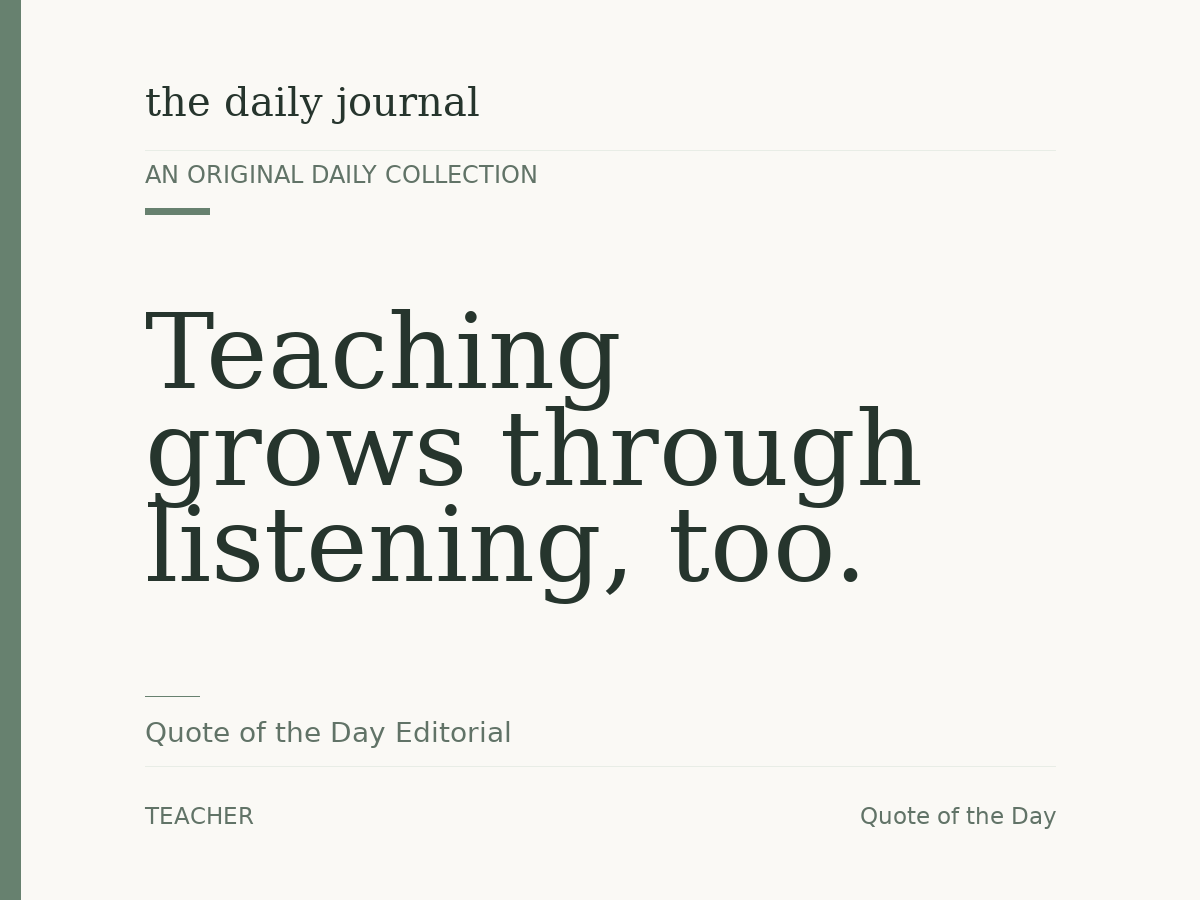
Teacher ↗“Teaching grows through listening, too.”
Quote of the Day EditorialListening to students helps teachers discover missing background knowledge, confusing examples, or unexpected interpretations. It is part of informed instruction, not simply being agreeable.