“A concrete offer often helps more than a vague intention.”
Offers work best when they name what can actually be done. Practical help makes it easier for someone else to accept, decline or adapt the support.
Brief, original quotes for a quick thought, caption or note. Discover today’s featured quote, what it means, and other thoughtfully selected words.
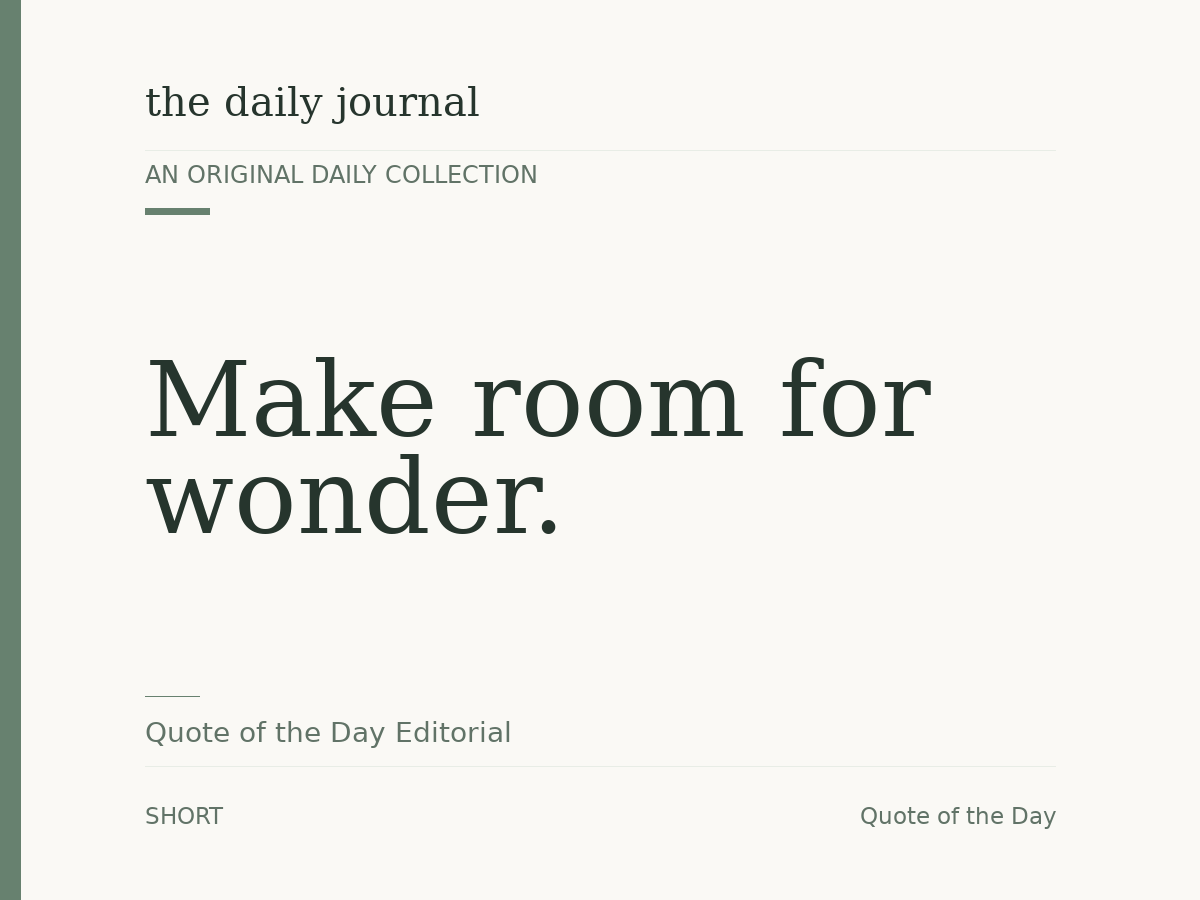
Make room for wonder.
— Quote of the Day Editorial
Wonder asks us to look again at what feels familiar. It invites curiosity without requiring a spectacular discovery or an expensive experience.
Browse other selections from our editorial library, with a little context for each.
“A concrete offer often helps more than a vague intention.”
Offers work best when they name what can actually be done. Practical help makes it easier for someone else to accept, decline or adapt the support.
“Sometimes it is enough to put away a distraction for one conversation.”
Giving someone an uninterrupted conversation can make a familiar interaction feel more considered. It is a simple action, though not everyone has equal access to quiet or private time.
“A modest action practiced consistently can outlast a dramatic start.”
A routine that survives ordinary days may contribute more than a burst of effort that cannot be repeated. Consistency has value when the action itself is worth doing.
“One clear question can change the meeting.”
Setting limits and treating someone kindly are compatible. The wording of a boundary should be respectful, but kindness does not require giving up the boundary itself.
“Clarity is kindness to the future reader.”
Someone reading a note, email or instruction later cannot ask what its writer meant at that moment. A clear explanation reduces the burden placed on the next person.
“One honest beginning outweighs ten imaginary finales.”
Repeatedly imagining the perfect conclusion can become a substitute for doing the first real piece of work. A modest, truthful start offers evidence to learn from.
Short quotes work well because they are easy to remember, read aloud, put in a card, or add to a caption. Brevity can sharpen a thought, but it also removes context; a line that sounds profound may be too vague to help.
Short quotes fit captions, quick texts, journal headings, or a moment of reflection. Fewer words can make a thought memorable, but they also leave less room for context.
Look for an idea that survives being read twice. If the words are concise but you cannot explain them in plain language, they may not be the right choice.
Short should not mean cryptic. Clear, honest language is usually more useful than abstract words that sound impressive.
Pair the line with the mood of the picture rather than repeating its literal description.
Choose something readable at a glance, then personalize with your own sentence.
Before sharing a brief line, make sure the meaning is clear. Add a sentence of your own if readers might interpret it in more than one way.
Which simple sentence would be worth remembering today?
Often, because they remain readable on small screens. Prioritize clarity and use a generous text size rather than crowding the image with extra decoration.
There is no fixed rule; a complete and memorable idea is more important than an exact character count.