Science ↗“A sample label is part of the experiment, not an afterthought.”
Quote of the Day EditorialGood records connect a sample to its origin, handling and measurement conditions. Confused labels can undermine a comparison even when the instrument operates correctly.
In context: A student team collects water samples for a class exercise. Before any measurement, they agree on identifiers and record when each sample was taken and what container was used, so they can compare observations without guessing which bottle came from where.
Science ↗“A second research team needs instructions more than admiration.”
Quote of the Day EditorialDetailed protocols and materials can help independent investigators assess whether a study can be repeated meaningfully. Approval of an earlier result is not a substitute for examining methods.
In context: A research group publishes promising soil measurements alongside its sampling locations, calibration notes, analysis steps and relevant limitations. A second laboratory can now see which procedures to reproduce and which site differences need to be recorded, even if its result is not identical.
Science ↗“Data can travel farther than the context that made them useful.”
Quote of the Day EditorialNumbers copied into a new report can lose information about methods, populations and uncertainty. Preserving that context is part of using scientific evidence responsibly.
Science ↗“Two seasons are not comparable merely because they share a name.”
Quote of the Day EditorialA comparison across years may depend on how and where measurements were collected. Changes in instruments or sampling can affect the interpretation of an apparent trend.
Science ↗“A microscope enlarges the view, not the reach of the conclusion.”
Quote of the Day EditorialA detailed observation can still come from a narrow sample or a particular set of conditions. Conclusions should not extend farther than the evidence and study design justify.
In context: In a classroom practical, a student describes structures seen on a prepared slide. Instead of claiming all specimens look identical, their report states which slide was used, how it was prepared and what observations were possible under the available magnification.
Science ↗“An empty cell in the table may reveal where the method stopped.”
Quote of the Day EditorialMissing data may arise from limits in access, sampling, measurement or documentation rather than from the phenomenon itself. Researchers need to describe that absence before interpreting the filled-in cells.
In context: A field team finds that temperature measurements are missing during several storms because the equipment lost power. Instead of filling every gap with a convenient average and moving on, they mark the missing periods, describe the failure and examine how the omissions affect the reported trend.
Science ↗“Facts deserve context as much as attention.”
Quote of the Day EditorialA scientific claim may be accurate within a particular population, instrument range or experimental condition. Including those boundaries prevents a narrow result from being presented as universally applicable.
Science ↗“The best science story includes the work behind the discovery.”
Quote of the Day EditorialThe work behind a finding includes recording methods, checking analysis and crediting contributors. Reporting only the dramatic conclusion can obscure the evidence that makes the claim assessable.
Science ↗“A good model is useful because we understand where it may fail.”
Quote of the Day EditorialScientific models deliberately simplify selected aspects of a phenomenon for particular purposes. Stating their assumptions and limitations helps prevent applying a useful model beyond the conditions where it has been tested.
Science ↗“The natural world is full of ordinary details worth investigating.”
Quote of the Day EditorialOrdinary observations can raise investigable questions when a method can distinguish competing explanations. Familiarity with a phenomenon is not itself evidence that its causes are understood.
Science ↗“A measurement becomes meaningful when we know how it was made.”
Quote of the Day EditorialA numerical reading depends on how an instrument, unit and procedure were used. Describing those conditions lets other people judge whether comparisons and conclusions are warranted.
Science ↗“Good scientific curiosity includes the courage to say we do not know yet.”
Quote of the Day EditorialScientists can specify what is uncertain without abandoning what is already well supported. Distinguishing open questions from established evidence helps readers understand the current limits of knowledge.
Science ↗“A useful experiment tells us something even when the hypothesis fails.”
Quote of the Day EditorialA result contrary to a prediction can reveal a flawed assumption, an unanticipated effect or a limitation in the study design. It may be informative even when it does not support the original hypothesis.
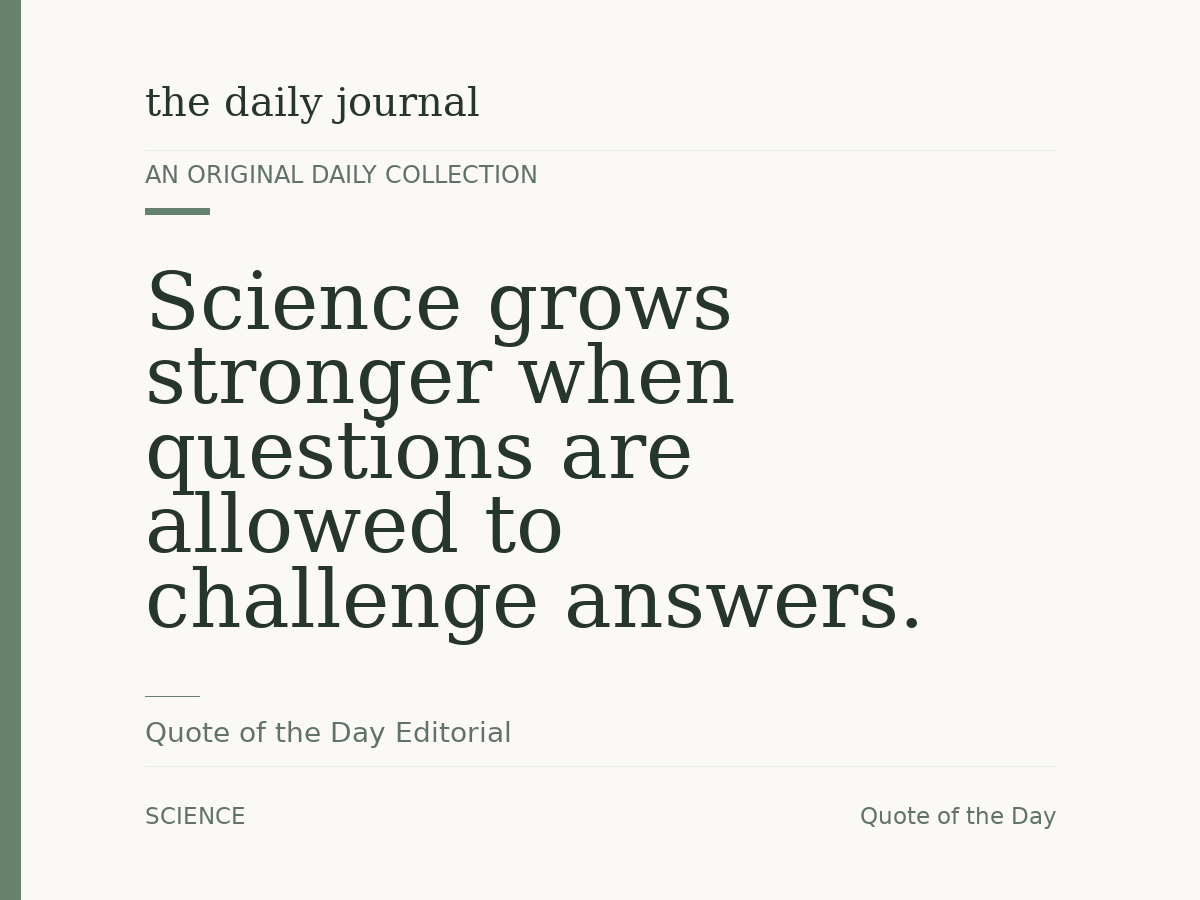
Science ↗“Science grows stronger when questions are allowed to challenge answers.”
Quote of the Day EditorialScientific explanations become stronger when evidence is allowed to challenge them, including ideas already widely accepted. This describes a practice of scrutiny, not a rule that every question deserves equal evidential weight.