Skip to content
One thoughtful reading, every dayNovember 11, 2026 · UTC edition
DAILY SCIENCE REFLECTION

Science Quote of the Day

Science quotes about evidence, honest uncertainty, experiments, discovery and responsible inquiry. Discover today’s featured quote, what it means, and other thoughtfully selected words.

 November 11, 2026 · UTC edition
TODAY’S SELECTION Science
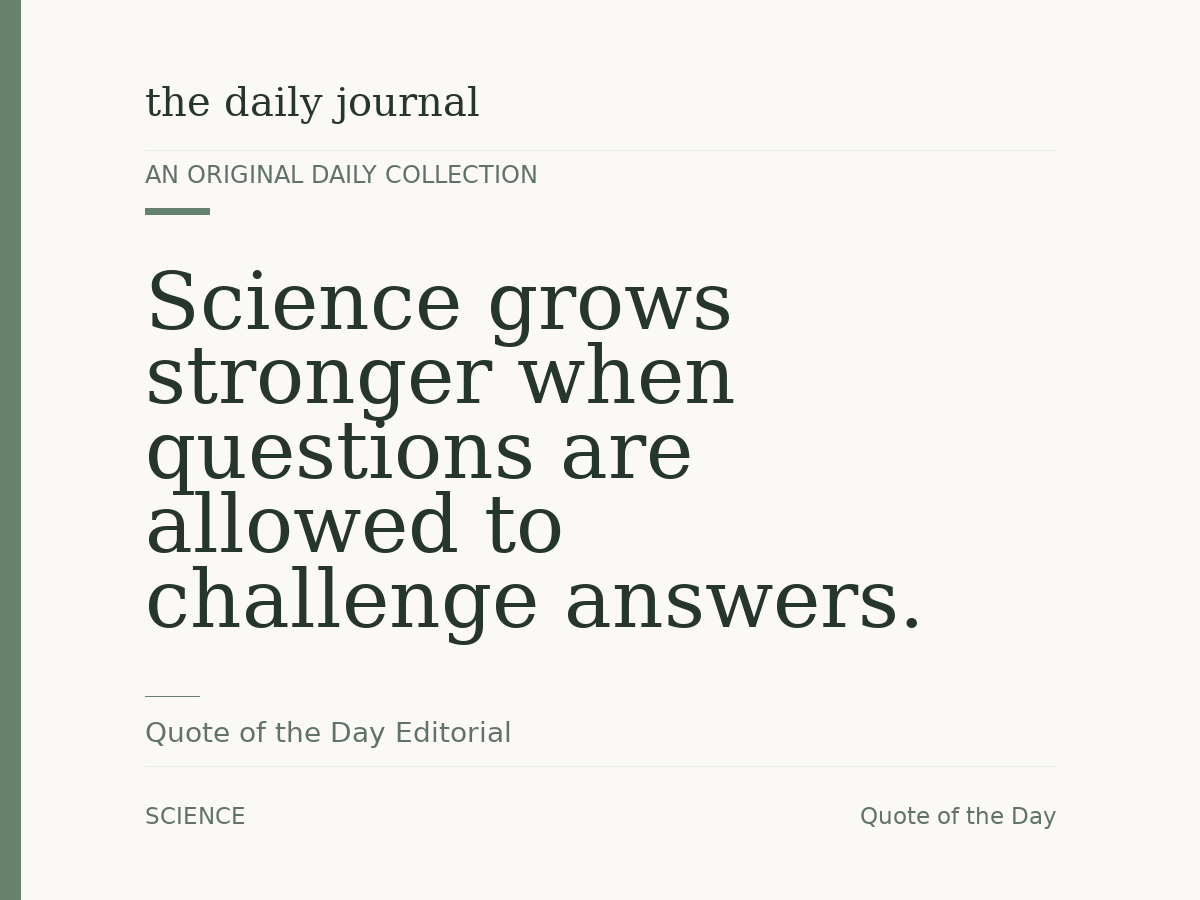
Science grows stronger when questions are allowed to challenge answers.

— Quote of the Day Editorial

Download PNG
READ BEYOND THE WORDS

What today’s quote means

Scientific explanations become stronger when evidence is allowed to challenge them, including ideas already widely accepted. This describes a practice of scrutiny, not a rule that every question deserves equal evidential weight.

KEEP READING

More science quotes

Browse other selections from our editorial library, with a little context for each.

Browse the library →
01
“The most useful lab note may record what went wrong before anything was discovered.”

Unexpected equipment behavior, handling mistakes and procedural adjustments belong in a faithful research record. Reporting such details can help others understand why a result is uncertain or difficult to compare.

02
“An honest negative result can narrow the next question even if it does not make headlines.”

When a prediction is not supported, careful documentation may narrow the next question or reveal a design problem. A negative result is most useful when the method can actually support the inference being drawn.

03
“Repeating an experiment is a form of respect for the first result, not an insult to it.”

Studies that independently gather new data can help assess whether earlier findings remain consistent. In the National Academies terminology this is replicability, distinct from recomputing results with the same data and code.

04
“Science advances through better explanations, not just larger piles of facts.”

Science joins measurements with explanations that can be investigated, compared and revised. Gathering more observations is not a substitute for asking whether the interpretation addresses the original question.

05
“Curiosity asks for evidence even when the answer is inconvenient.”

An appealing claim should be evaluated with the same methods as an inconvenient one. This expresses the value of evidence while acknowledging that scientific confidence can differ sharply among claims.

06
“A sample can be large and still answer the wrong question.”

A large dataset does not necessarily answer the intended research question if sampling or measurements are poorly matched to it. Study design remains important even when a result looks statistically precise.

THE READING GUIDE · SCIENCE

Questions deserve evidence, not just confidence

Science quotes can celebrate curiosity while reminding us that explanations must be tested. Honest uncertainty is not weakness; it is part of examining evidence, improving models, and distinguishing observation from speculation.

How to find the right words

Science quotes should encourage curiosity alongside evidence, uncertainty and sound methods. None of these original lines is presented as a quotation by a famous scientist.

Choose language that invites investigation rather than claiming that scientific thinking produces instant certainty about every issue.

Consider the meaning, not only the mood

Avoid using a famous scientist's name as proof that a claim is true. Evidence and scientific consensus matter more than celebrity.

WHERE THESE WORDS FIT

For a classroom experiment

Ask what result would support or challenge a proposed explanation.

For reading a headline

Look for methods, sample size, limitations, and the difference between correlation and cause.

IN PRACTICE

A way to carry the idea forward

Take a familiar claim and ask how it was measured, what alternatives were considered and where the limitations might lie.

What observation or experiment would help clarify this question?

QUESTIONS ANSWERED

Are these real quotations from scientists?

No. They are original editorial lines about the scientific process. When looking for a historical scientist’s words, verify the original publication or a dependable collection.

How do science quotes become useful?

Connect them to an observable question, a way to test it, or a reason to revise an explanation.