“You can examine a first impression before you build a whole argument around it.”
First impressions may omit facts or context important to the whole situation. The thought encourages a second look where time allows rather than reflexive certainty.
Original Stoic-themed reflections about judgment, virtue, self-command and perspective, not misattributed ancient quotations. Discover today’s featured quote, what it means, and other thoughtfully selected words.
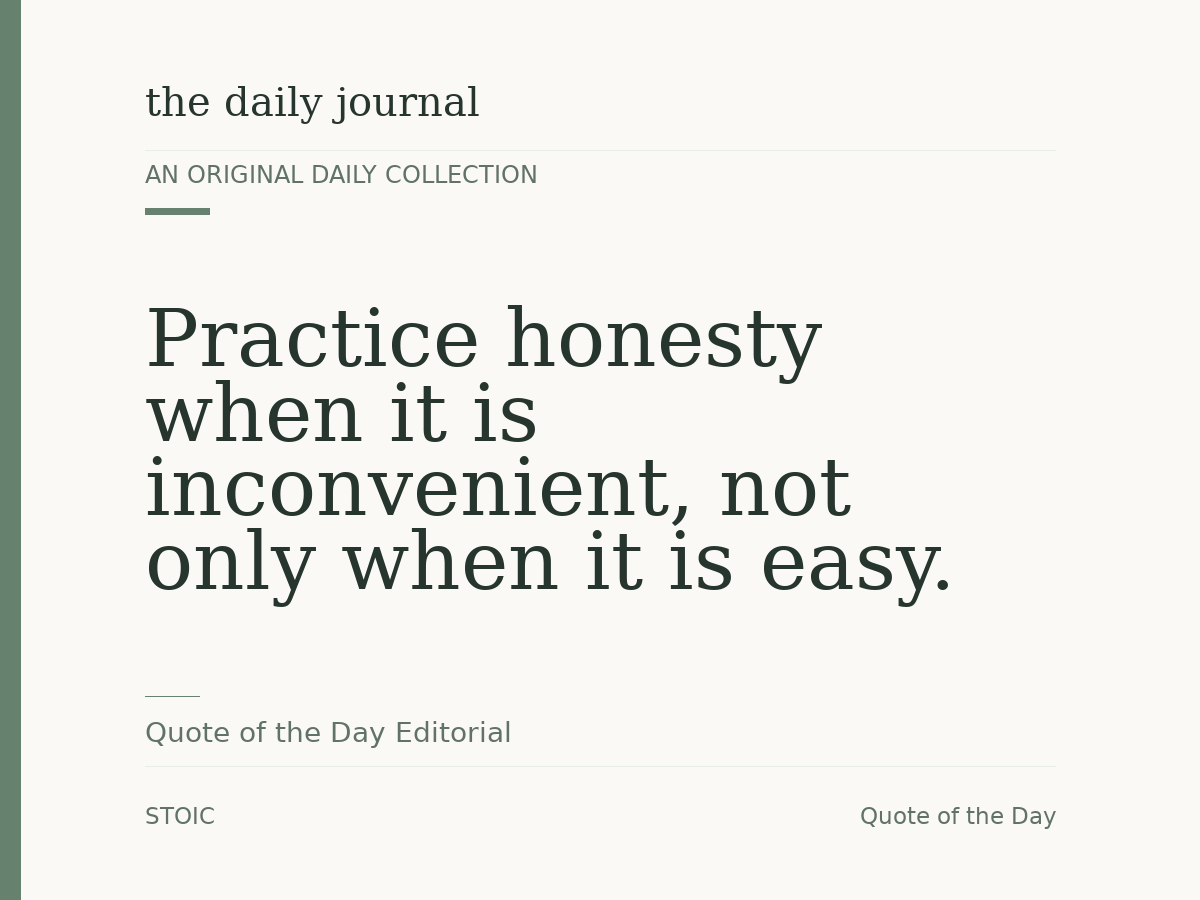
Practice honesty when it is inconvenient, not only when it is easy.
— Quote of the Day Editorial
Honesty is most revealing when the truth has a social or practical cost. The quotation places integrity in ordinary choices, without demanding that people disclose private information.
Browse other selections from our editorial library, with a little context for each.
“You can examine a first impression before you build a whole argument around it.”
First impressions may omit facts or context important to the whole situation. The thought encourages a second look where time allows rather than reflexive certainty.
“Self-command begins by admitting the moment has already happened.”
An event that has already occurred cannot be undone by argument with its timing. Recognizing that fact permits attention to what can still be repaired or protected.
“Before you blame the hour, ask what action still belongs to you.”
An unpleasant time constraint may be real and unavoidable. Looking for an available next action can be useful without blaming someone for the limits they face.
“A strong feeling can be heard without being appointed judge of every choice.”
Feelings deserve acknowledgment even when they do not settle every question. The line invites deliberate judgment without claiming emotions are enemies of reason.
“Your character is tested in ordinary exchanges long before the grand crisis arrives.”
Everyday dealings give people repeated chances to practice fairness. The quotation resists treating virtue as something reserved for dramatic or visible moments.
“Practice for inconvenience on a small day so it does not surprise you on a hard one.”
Small preparation can make future inconvenience less unfamiliar, although outcomes remain uncertain. The line advocates practical readiness rather than treating hardship as a contest.
Stoic-inspired quotes can help readers distinguish their own choices from external outcomes. This page uses original modern reflections on Stoic themes, not lines falsely attributed to Marcus Aurelius, Seneca, or Epictetus.
These are modern, original Stoic-inspired reflections, not quotations claimed to come from Marcus Aurelius, Seneca or Epictetus. They focus on judgment, integrity and what lies within your influence.
Read these thoughts as invitations to examine reactions, character, and responsibility. Classical Stoicism is a wider philosophy, so a modern one-line summary should not replace the original works.
Avoid using Stoicism as an excuse to suppress emotions or ignore injustice. Self-command should make thoughtful action possible, not erase concern for others.
Separate your response from the event you cannot reverse.
Evaluate whether it contains useful information before deciding how much weight to give it.
When something frustrates you, identify the facts, the decision still available and what is outside your control. Consider what response best fits your values.
What is mine to decide here, and what am I trying to control unnecessarily?
No. They are newly written reflections informed by broad Stoic themes. For historical quotations, consult reliable editions and translations of the original authors.
No. They are original editorial lines inspired by related philosophical ideas, clearly separate from sourced classical texts.